Firequacker Embroidery Design: A Business Review
First Impressions for Commercial Merchandise
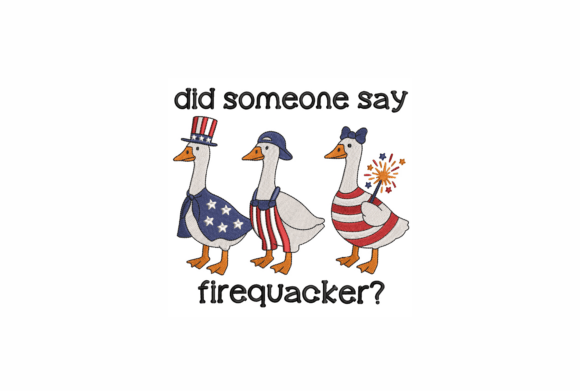
As an embroidery designer evaluating assets for small business merchandise, my first impression of the Firequacker Embroidery Design is that it strikes a difficult balance between festive humor and commercial viability. The concept, featuring three charming geese with the phrase "DID SOMEONE SAY FIREQUACKER," immediately signals a playful, approachable brand personality. For businesses in the bakery, pet supply, florist, or boutique sectors, this machine embroidery design offers a distinct alternative to generic patriotic clip art often seen during Independence Day promotions.
The visual hierarchy appears well-suited for retail environments. The combination of character illustration and bold typography suggests high visibility from a distance, which is crucial for staff uniforms or market stall signage. However, the whimsical nature of the geese means this design carries a specific tone; it is friendly and rustic rather than corporate or austere. When reviewing this embroidery file for professional use, I see it functioning best as a conversation starter on customer-facing items like tote bags and aprons, rather than subtle branding on formal wear. The charm lies in its specificity, making it an excellent candidate for businesses wanting to showcase a handmade product aesthetic with a sense of humor.
Performance Across Branded Apparel and Accessories
In real-world application, the versatility of the Firequacker Embroidery Design depends heavily on the substrate. For apron embroidery in cafes or bakeries, this design performs exceptionally well. Aprons provide a flat, stable canvas that accommodates the likely stitch density of three detailed geese and text without distortion. The humor aligns perfectly with food service environments, turning a standard uniform into a memorable part of the customer experience. Similarly, as a tote bag design for farmers' markets or craft fairs, the artwork serves as both branding and a standalone decorative element that customers are happy to reuse.
For cap embroidery, the design requires careful consideration. Caps present a curved surface that can distort complex illustrations. If the Firequacker Embroidery Design includes a version optimized for headwear, it could serve as a fantastic seasonal promotional item. However, if the file is a single large format, resizing it down for a cap front may result in lost detail in the geese’s facial expressions or clothing. In such cases, I recommend using the design primarily on flat goods like work shirts, tea towels, or embroidered patches.
Speaking of patches, this artwork has strong potential as an embroidered patch for backpacks, jackets, or collector merchandise. Patches allow for higher stitch counts and finer details because they are stitched on stable twill before being applied to the garment. This makes them ideal for preserving the integrity of the "Firequacker" pun and the geese's costumes. For Etsy sellers or creative studios, offering this as a limited-edition holiday patch creates urgency and adds value to your small business merch lineup without committing to full apparel production runs.
Technical Considerations and Production Limits
While the aesthetic is appealing, technical execution determines whether the Firequacker Embroidery Design translates to a sellable product. Small business owners must verify the minimum size requirements before purchasing this digital embroidery file. Text-based designs with humorous phrasing rely entirely on legibility; if the lettering shrinks below 0.25 inches in height during resizing, the joke is lost in a blur of thread. Always check the original dimensions and recommended reduction limits provided by the digitizer.
Stitch density is another critical factor. Three geese plus text implies a significant number of stitches. On lightweight fabrics like performance tees or thin cotton, this density can cause puckering or fabric damage. You must pair this design with appropriate stabilizer—likely a cutaway for stretchy knits or a heavy tear-away for structured caps. Testing on the actual fabric texture you intend to use is non-negotiable. A design that looks crisp on stiff denim may sink into loose-weave linen or burlap, obscuring the fine details of the geese’s attire.
Furthermore, consider the color change sequence. Complex multi-color designs increase production time and thread consumption. Before running a bulk order for custom apparel, review the color chart to ensure the thread colors match your existing brand palette or inventory. If the design uses twenty distinct shades, it may not be cost-effective for low-margin items. Conversely, if the colors are standardized, it streamlines production for commercial embroidery projects.
Impact on Brand Identity and Customer Engagement
Integrating the Firequacker Embroidery Design into your product line affects more than just aesthetics; it influences brand identity and perceived value. Humor humanizes a business. When customers see staff wearing a witty, well-executed design, it lowers barriers and fosters connection. This is particularly valuable for local businesses competing against impersonal big-box retailers. The "handmade" quality of machine embroidery reinforces the idea that your business cares about craftsmanship and detail.
However, consistency is key. This design should complement, not clash with, your core logo. Use it as a seasonal accent or a secondary mark rather than replacing your primary identifier. For example, place your main logo on the left chest and the Firequacker design on the sleeve or back yoke. This maintains professional recognition while adding seasonal flair. High-quality execution builds trust; sloppy registration or thread breaks on a funny design make the business look amateurish rather than charming. The finished product must reflect the same standards as your core offerings.
Designer Notes for Successful Implementation
To maximize the ROI on this embroidery file, follow these practical steps before full production:
- Verify Licensing: Confirm that the Firequacker Embroidery Design includes commercial licensing for selling finished products. Personal-use-only licenses do not cover branded merchandise sales.
- Create Printable Mockups: Before stitching, use software to generate a printable mockup. Show this to stakeholders or test audiences to gauge reaction to the humor and placement. It is cheaper to adjust a digital proof than to unpick stitches.
- Test in Black and White: Run a grayscale or single-color test sew-out first. This reveals structural issues with spacing and underlay that color might hide. If the design reads well in monochrome, it will excel in full color.
- Check Hoop Size Compatibility: Ensure the design fits within your machine’s maximum embroidery area with adequate margin for hoop clearance. Trying to squeeze a design into a hoop that is too small leads to alignment errors.
- Evaluate Contrast: Test the design on both light and dark backgrounds. White text on a white apron disappears; ensure sufficient contrast exists for readability in various lighting conditions.
- Compare Against Assets: Place the Firequacker design beside your current design assets. Does it share a similar style weight? Visual cohesion across your merchandise line prevents a disjointed brand presentation.
- Document Settings: Once you achieve a perfect sew-out, record the stabilizer type, needle size, tension settings, and hooping method. This ensures repeatability for future reorders of Independence Day merchandise.
By treating the Firequacker Embroidery Design as a professional asset rather than just a cute graphic, small business owners can leverage its humor to drive engagement and sales. Success lies in respecting the technical constraints of Embroidery while embracing the unique personality this design brings to your brand. Always prioritize testing and quality control to ensure that the final stitched product delivers the intended smile to your customers.